The Shift from Reactive to Intelligent Physical Security

How AI is Redefining Physical Security
For much of the past two decades, physical security has evolved incrementally while the operating environment around it has transformed dramatically. Despite advances in camera resolution and network connectivity since the early 2000s, physical security has remained fundamentally reactive and siloed — until modern AI analytics enabled real-time intelligence and proactive response.
This gap between technological capability and operational need has become increasingly difficult to ignore. Today’s organizations require security systems that do more than capture evidence; they must actively contribute to risk reduction, operational awareness and business continuity.
Artificial Intelligence has emerged as the inflection point that is redefining what physical security can and should deliver.
Reframing Security
Traditional physical security systems were designed to document events after the fact. While effective for investigation and compliance, they offered limited value in preventing incidents or identifying emerging risks.
AI fundamentally changes this framework.
By continuously analyzing live video and access data, AI-powered security platforms can identify abnormal behavior, unauthorized access and risk patterns as they develop. This enables earlier intervention, faster response and more consistent decision-making — without relying on constant human monitoring.
The result is a shift from passive observation to active situational intelligence through proactive alerts and intervention.

Operational Efficiency at Enterprise Scale
As organizations expand across locations and geographies, legacy security models become increasingly inefficient. Scaling typically requires additional personnel, fragmented systems and manual processes that introduce both cost and risk.
AI-driven platforms address this challenge by automating core security functions such as footage management, incident detection and alert escalation. Intelligent search, automated archiving and centralized oversight give organizations back time and allow security teams to operate more effectively across large environments without proportional increases in staffing.
In this model, efficiency is not achieved by reducing oversight, but by improving focus and precision.
Defining the Modern Physical Security Platform
As expectations evolve, organizations evaluating physical security solutions should look beyond traditional feature sets. A modern platform should provide:
- Real-time threat detection supported by AI-driven analytics
- Scalability across distributed environments without operational complexity
- Integration with existing infrastructure and business systems
- Automated workflows for alerts, escalation and retention
- Strong data governance and privacy protections
- An intuitive interface that supports adoption and accountability
- High-cost integration avoidance through native components that work together
These capabilities are no longer differentiators; they are becoming baseline requirements.
 Why Verkada Represents a Structural Shift
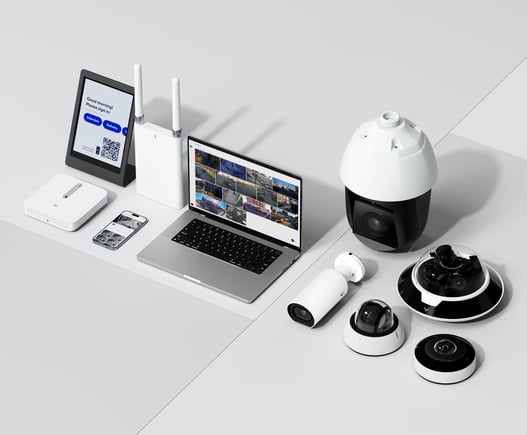
To illustrate what this transformation looks like in action, Basic ITS points to platforms designed specifically for united, AI-powered security environments. Verkada is one such solution, representing a meaningful departure from legacy physical security approaches to intelligence-driven security infrastructure.
By unifying intelligent hardware, cloud-native architecture and AI-driven analytics into a single platform, Verkada enables organizations to move beyond fragmented systems and reactive workflows.
Because the platform is cloud-centric, scaling to new sites, devices, geographic regions or around the globe is significantly less complex than with conventional systems. New features, such as generative AI and other AI enhancements, are delivered automatically through software updates, future-proofing investments without costly hardware replacements.
Where legacy AI tools often focus narrowly on video analytics, Verkada’s architecture unifies multiple security domains — video, access, alarms, environmental sensors, intercoms, visitor systems and mailroom — under one policy and alerting framework. This enables richer context for incident response and more consistent workflows across the enterprise.
More importantly, Verkada’s approach reflects a broader shift in how physical security is positioned — moving from a cost center focused on loss prevention to a strategic function aligned with operational resilience and risk management.
Looking Ahead
AI is not simply enhancing physical security; it is redefining its role within the organization.
After nearly two decades of incremental progress, the industry is undergoing a fundamental transformation — one that prioritizes intelligence, integration and proactive response. Organizations that recognize this shift and modernize accordingly will be better positioned to manage risk, protect people and property, and operate with confidence in an increasingly complex environment.
Physical security is no longer about recording what happened. It is about understanding what is happening — and acting before risk becomes impact.
 |
ABOUT BASIC ITS Basic ITS is an IT solutions company headquartered in central Illinois that prides itself on being more than a technology company — a solutions company. They leverage decades of experience and the latest technologies to deliver innovative, customized IT solutions for enterprises and healthcare organizations. Dedicated to service excellence, Basic ITS works seamlessly with clients to provide everything from AI Physical Security Systems, IT staff augmentation, PC imaging, to hardware sales, always with a focus on communication, reliability and helping enterprises succeed now and into the future. |